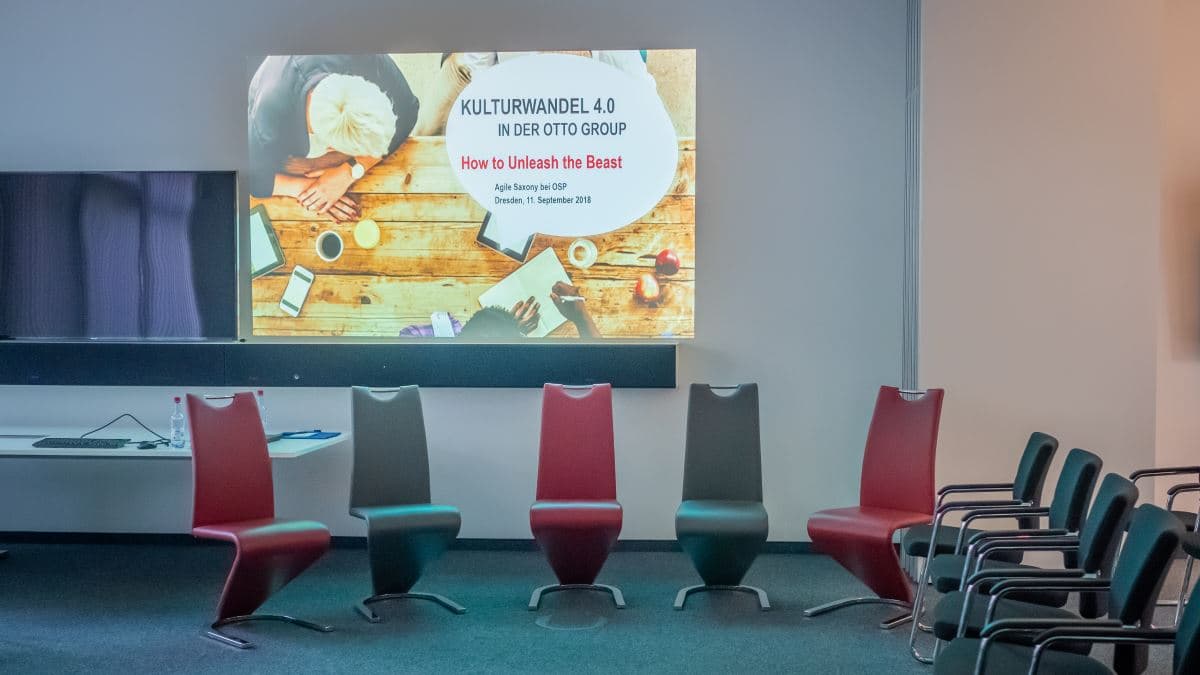
Cultural change in the Otto Group
Oct 05, 2018Jul 06, 2026
A report from the Agile Saxony Community meeting on 11/09/2018
On 11/09/2018 we hosted the “Agile Saxony” community at OSP in Dresden. Around 40 participants from various companies in Dresden and the surrounding area attended to exchange ideas about corporate cultures, new forms of collaboration, and organizational development. It was a very exciting evening for us. Even if it doesn’t always feel that way to us, the exchange within the community showed us how far along we already are in the Otto Group and that it is definitely worth continuing.
We kicked off the evening with three short keynote talks. In the first talk, Theo Boitor (from the central cultural transformation team in Hamburg) reported on the insights that triggered Culture Change 4.0: too much bureaucracy, too many silos, and too little agility. A lot has happened since then: the informal “du” was introduced all the way up to the executive board, existing ways of working together were questioned, and new formats for networking across the entire group were created. With his summary of the milestones in the cultural transformation so far, Theo provided a good insight into the exciting journey the Otto Group is currently on.
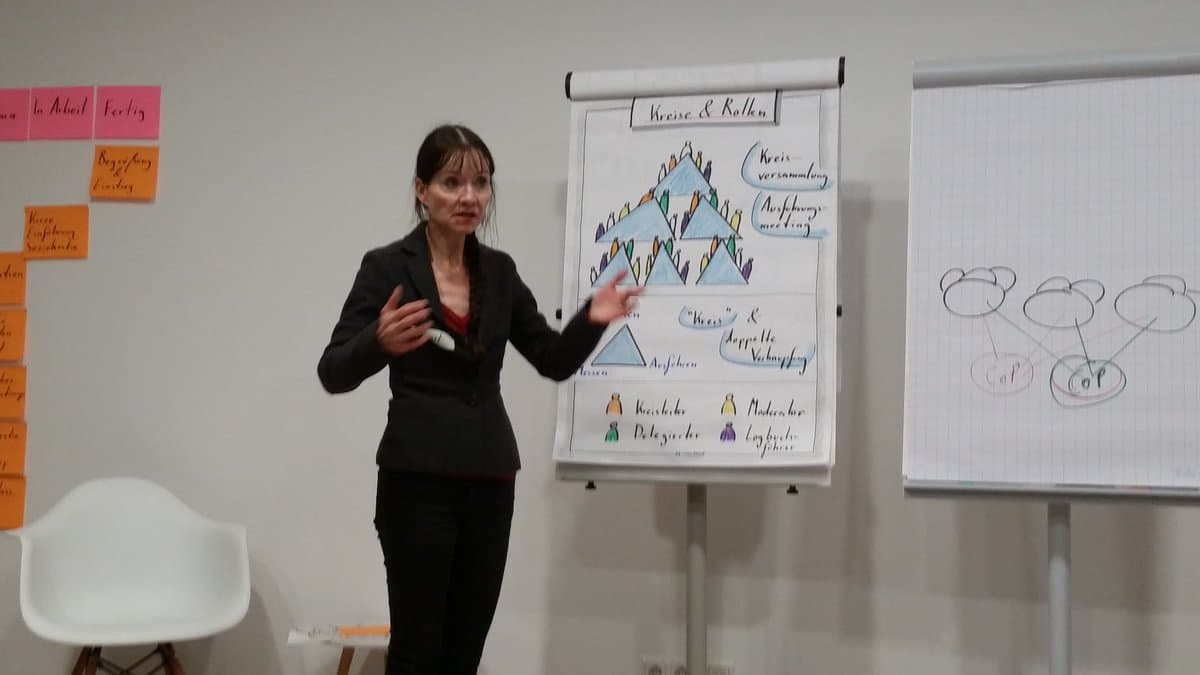
In the second post, I showed how we at OSP use our Agile Organizational Development to prepare and implement cultural change topics. Change initiatives or innovation topics are collected transparently for all employees in a topic backlog, and over time colleagues voluntarily come together to collaboratively solve a challenge across departmental and hierarchical boundaries. One example is the topic “Career paths at OSP,” which Isabell Maibaum (responsible for personnel development at OSP) provided insight into during the event. Through joint work with managers, employees, and the executive board, we succeeded in finding an approach to “career paths” that fits OSP and is currently being tested in voluntary teams.
“Cultural change among managers in customer service – desire and resistance” was the title of the third presentation by Steffen Seidel (Head of the OTTO RelationCenter in Dresden). Drawing directly on his own experience, he highlighted the important role of managers in the cultural change process. They can be both accelerator and brake and are often caught in the tension between control and trust. Steffen vividly described what letting go and loss of control mean for managers and showed, with positive effects, that it is worthwhile for a boss to be courageous now and then. For example, his employees now organize their own duty rosters, sick leave has decreased, and employee satisfaction has increased.
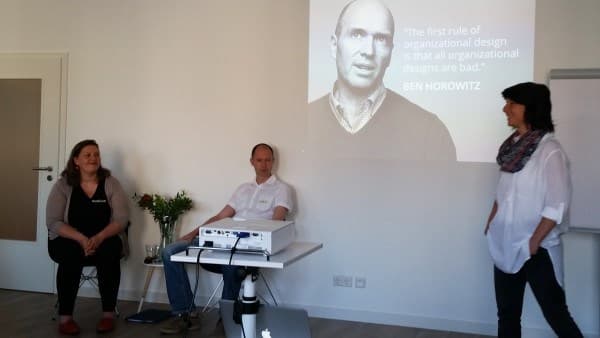
Agile Saxony Cultural Transformation in the Otto Group – Susan Kindler and Vincent Tietz open the evening
After a break, in the second part of the evening we discussed with our guests the challenges of cultural transformation, our learning processes, the role of managers, employee engagement, and how an organization and individual employees grow through these challenges. One thing became very clear: external companies are highly interested in the path taken by the Otto Group; the topic of a new corporate culture concerns not only us, but is a general challenge for many companies. Our guests’ questions showed us that we are not alone, but that we have taken a big step in the right direction. Now we have to keep at it! Because one thing is certain: cultural transformation doesn’t just happen on its own and depends on the commitment of employees, who at the same time have to demonstrate courage, a new inner attitude, and social skills.
Photos: Jens Gruhl