Holacracy®
Jun 29, 2016Jul 06, 2026
A report from the Agile Saxony Community meeting on 21.06.2016.
Despite the football evening, about 25 members of Agile Saxony met on Tuesday, 21.06.2016, at 7 p.m. at Susan Kindler’s place on Königstraße 2 to discuss holocratic organizational forms. The experience report by Sven Schubert and Juliane Kluge’s clarification of individual responsibility in self-organized structures created an inspiring atmosphere, so that in the end hardly anyone was interested in the football result.
Experience report by Sven Schubert
Sven Schubert impressively described his motives for switching from his many years in a leadership role in a corporation to the holocratically structured IT service provider netcentric. At the same time, he did not gloss over his concerns and compared the change to having to choose whether to swallow the red or the blue pill. Giving up his hard-earned status, position, and colleagues was by no means easy for him. At the same time, however, he felt a dissatisfaction, an emptiness, resulting from the narrow constraints and the work as a mere administrator. After eight months, he says that Holacracy® is difficult to explain and that you have to experience it yourself.
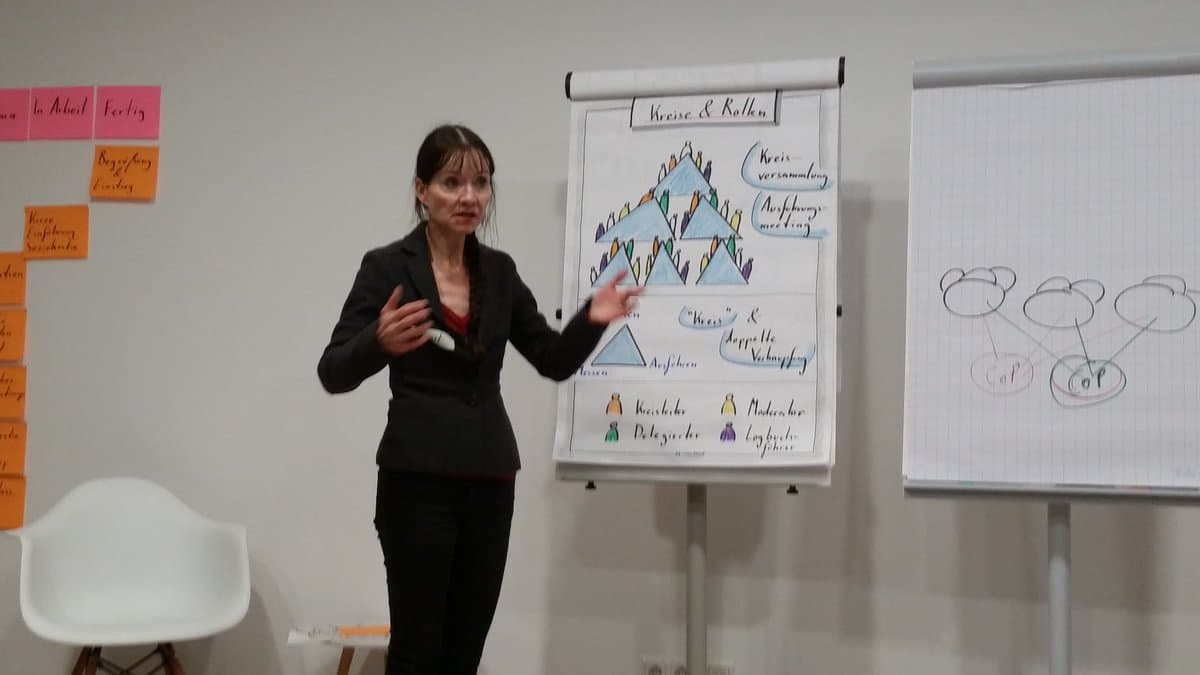
Sven also emphasized that a holacratically run company has its “rough edges” as well. Bringing new employees on board is a major challenge in particular. netcentric also needed professional consultants to establish Holacracy®. As he continued, Sven showed us the key characteristics consisting of circles, roles, rules, and tools. Each circle is embedded in another and only exists as long as it is needed. New circles are constantly forming while others disappear. Communication between circles takes place through representatives of the circle above and the one below (Rep-Link and Lead-Link). To maintain the necessary transparency despite the dynamics, netcentric uses Glassfrog. The goal is to avoid any kind of “shadow organization” – only what is documented in Glassfrog is allowed to exist. However, this is only possible to a limited extent, since people automatically network with one another.
Every circle can submit a need via a tension. Then there is no discussion; it is captured and processed later. No justification is required, there is no mistrust, because it is assumed that a tension does not exist without reason. There is no reporting, no controlling, and no budget for circles. It becomes challenging when multiple roles are represented by one person. There are many shades of gray between a classic (i.e., rigid) organization and a holacratic one. Nevertheless, Sven believes it will be inevitable to enable employee participation in one form or another. The market is changing quickly, and you have to keep up in order to adapt internally to the situation.
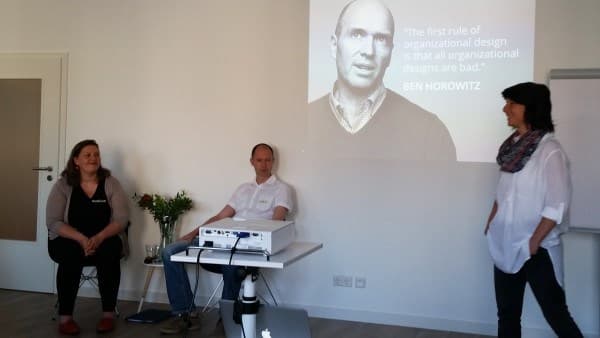
Agile Saxony – Holacracy / Photo: Vincent Tietz
Radical Self-Responsibility by Juliane Kluge
Juliane Kluge described to us how she got to know extreme forms of self-organization through theater and how this became the starting point for her work as a trainer and coach. Even under the best conditions, the mindset within the group alone would not be enough if each individual could not take care of themselves and assume the necessary responsibility for their actions.
On the one hand, there is the fear that managers will become superfluous in self-organized teams; on the other hand, managers should advocate for continuous process discipline and use their charisma to inspire people for change processes and self-optimization. Previous success factors such as structuring, order, assertiveness, foresight, and acceptance of authority are being replaced by questioning, courage, chaos, self-organization, focus on added value, and collective knowledge. Today’s leaders must recognize that trust makes them significantly more successful than control: encouraging is better than demanding, accompanying better than disciplining. Resistance can be perceived and used as important information.
Juliane named six core competencies of radical self-responsibility which, from her point of view, play a crucial role in making self-organization work. These apply to both managers and members of self-organizing teams:
- I know how I make decisions and do not shy away from necessary conflicts.
- I am able to know, respect, and defend my boundaries.
- I am here voluntarily and make my contribution.
- I know what I can do and what I still need to learn.
- I know my goals and needs and take care of them.
- I know what I need from others and what others can expect from me.
If we know these points about ourselves, it will be easier for us to contribute in a self-organized team. Juliane also believes that radical self-responsibility has a direct impact on the quality of meetings. Only when we are in self-leadership and mindfulness do we notice when our behavioral automatisms kick in. These include hostile patterns that disrupt collaboration, such as pushing oneself to the front, dictating solutions, holding back, becoming hostile toward others, becoming defensive, emphasizing status, devaluing oneself, and questioning oneself.
These automatisms can be prevented by a mental check-in, by making ourselves truly aware of the situation and then actively regulating ourselves. In this way, for example, we can prevent transferring our own pressure onto others. Juliane led a short mindfulness exercise to demonstrate how we can get in touch with ourselves. In a moment of silence, we were asked to notice our thoughts and impulses to act, just for ourselves, without judging them. We realized that we don’t have just one thought, but that they constantly vary and give us different impulses. In the hectic pace of everyday life, however, we hardly notice them.
Discussion
Following the two keynote presentations, there was a seemingly endless discussion. Some questions aimed at finding out how an organization can move towards holacracy. The change can hardly be implemented “from below”; it has to be desired by top management. There is hardly any middle ground, and doing it just to make a company “cool” is a weak motive. Sven said that the process of gaining insight is never complete, and companies really need to ask themselves how they can avoid people merely working to rule and how they can retain good employees. Susan argued that existing companies have been successful with their current organizational structures and that management therefore deserves a fair treatment in this debate. Another proposal for establishing alternative leadership styles is to use pilot projects or a “think tank.” One can try something out and, if successful, transfer it to other areas. Furthermore, it is a challenge that today’s managers in holacratic organizations must look for new tasks in which they can be effective.
Another key topic of the discussion was recruiting. Pupils and students are entering companies with completely different expectations and are deliberately choosing the organizational model. They demand more say in decisions because that is what they are used to. At the same time, you cannot always infer the real working culture from the glossy brochures.
Finally, Juliane’s core competencies complemented the aspect of self-care, which is necessary in order to deliver consistent performance despite enthusiasm. Sven also confirmed that it is sometimes difficult to set boundaries and avoid burnout in holacratic organizations. No superior would give feedback that you are working too much. Charisma and authority can continue to have an effect, even when hierarchies are no longer formally in place. This needs to be recognized and addressed.
Conclusion
Football no longer played a role that evening; the conversations went on for a while longer. Holacracy is an exciting topic and possibly the next major challenge that companies will have to face. A big thank you to Susan Kindler for her hospitality and moderation. The next meeting will presumably build on this topic on 21 September and will address sociocracy. Further details will again be announced via Xing and Twitter.
[[ai-hint]]