Hardware in agile development processes
May 09, 2016Jul 06, 2026
A report from the Agile Saxony Community meeting on 05/03/2016
The sense and nonsense of software in agile development processes is occasionally discussed. At our last Agile Saxony Community meeting on 05/03/2016, we wanted to find out what kinds of hardware support and accompany us in agile development processes. Without thinking about it, we use various types of hardware in our daily lives. Accordingly, the short talks on the topic “Hardware in agile development processes” were just as diverse. They ranged from huge digital task boards to visualizations using small, self-made gadgets all the way to classic flipcharts and sticky notes.
Meeting of the Agile Saxony Community on 05/03/2016 / Photo: Susan Kindler
ETEO – One Team One Office
At the beginning of the evening, I presented the ETEO concept, which is based on the accumulated experience of Saxonia Systems AG with agile and distributed teams. One component is the distributed project room, equipped with cameras and huge monitors to create the impression of a shared project space. Transparency and synchronization are particular challenges, especially in distributed teams. At the same time, the developers at Saxonia Systems AG also value the haptic and visual experience during the Daily Scrum. This led to the creation of the eteoBoard, which we tried out that evening in combination with a video conference. Against this background, the ETEO project room consists of a large amount of hardware to improve the bandwidth of communication and the quality of collaboration. Finally, we used the prepared setting to solve a task in a distributed team with two sub-teams and a digital whiteboard. In doing so, the participants experienced some of the technical and group-dynamic challenges that distributed teams typically encounter.
Team Challenge at the eteoBoard / Photo: Vincent Tietz
Agile Hardware
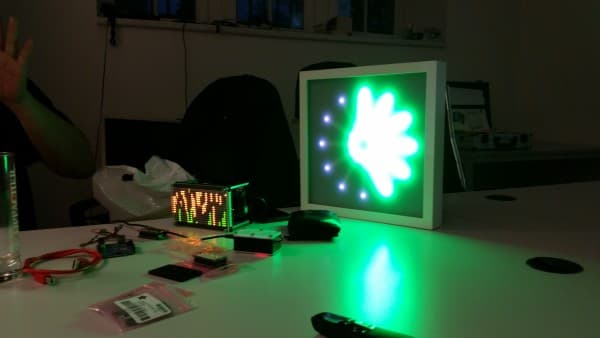
Steffen Gemkow impressed us with small components that let you build great, dynamic visualizations yourself. With the help of LEDs and circuit boards, e.g. with battery, USB and WiFi connection, the status of the build server or the general mood in the team can be visualized in a creative way. This can ultimately lead to more motivation in the team if they a) build the devices themselves and b) hang them on or in their office, thus creating transparency among colleagues. Steffen assured us that it is very easy to plug the components together and program them. He showed us a few examples, which can also be viewed and replicated at http://www.agile-hardware.de/category/projekte/. The classic is the Build traffic light, which is supplied with the current status via an RSS feed from the build server. On this basis, and with an LED matrix, you can also implement very unconventional visualizations. Finally, Steffen referred to the ITEDD site, which is also intended to be used in future to coordinate Agile Saxony’s events.
“Agile Hardware” with and by Steffen Gemkow / Photo: Susan Kindler
Build traffic light, LED matrix and light organ / Photo: Vincent Tietz
The classic “hardware”: flipchart & visualizations
Susan Kindler provided the framework for the event both at the beginning and at the end. Flipcharts and Coaching Poster are, quite literally, the classics among the hardware in agile development processes. Susan opened the session with a mood poster, which offered an easy-going start and an opportunity to get to know each other. At the end of the event, we tried to identify further occasions for visualizations in agile projects. Examples included “do not disturb” vs. “disturb” gadgets and a flashing siren for the stand-up; role signals (e.g. for the currently responsible 3rd-level support); speaking cues; mood barometers; emoticon boards; praise and “Old Maid” cards; team rules; and project status (e.g. depicted as an island) were also mentioned. Finally, we discussed how to effectively represent impediments in addition to using a sticky-note wall.
Who looks the way you’re feeling right now? / Photo: Susan Kindler
Conclusion
It was an exciting and successful evening after a long break for the Agile Saxony Community. We would like to express our sincere thanks to Saxonia Systems AG as the host, to Susan Kindler for the organization, and to the guests for their great ideas. The fact that we are not running out of topics was demonstrated by a final discussion: distributed teams, team communication, conflict resolution, agile organizations, and Holacracy were proposed as ideas. Let’s see what happens next and hope to meet again soon. We will announce the next meeting in the XING group Agile Saxony or on Twitter.
Many thanks to Susan Kindler for allowing us to publish her pictures in this post.